The Irwin Corpus™ Lexicon
The Irwin Corpus™ Lexicon gathers the language of the archive: terms, characters, maps, and field structures that help make patterns visible.
How to Read the Irwin Corpus™ Lexicon
The Irwin Corpus™ Lexicon is not a conventional glossary.
Its terms are not simply invented words, aesthetic labels, or private language. They are observational instruments: ways of naming recurring movements of meaning, relation, structure, continuity, and correction.
A term belongs in the Lexicon when it protects a distinction that ordinary language might otherwise flatten.
These are not ordinary definitions
A dictionary definition tells you what a word means.
A Lexicon entry asks more than that. It asks what the term helps you notice, what field it belongs to, what it connects with, what it must not be confused with, and how it behaves when it moves through practice.
Each term has a field
Terms in the Irwin Corpus™ Lexicon do not stand alone.
Each term belongs to a field of relationships. It may generate, stabilise, translate, constrain, preserve, reveal, or correct another term. A term is therefore read not only by its definition, but by its role in the wider Corpus field.
Some terms have characters
Some Lexicon terms are also carried through character plates.
These are not fictional characters in the ordinary sense. They are recognition figures. They help the reader ask: how would I recognise this movement if I encountered it in the wild?
Some terms belong to maps
Relationship Maps, Field Mechanics, and Transition Maps show how terms connect, operate, and change.
The Lexicon is not only a list of terms. It is a network of movements. The maps help show what each term depends on, what it affects, what it may become, and what happens when it is misread.
Some terms are stable, others are still emerging
Not every term has the same status.
Some entries are active canon. Some are developing. Some may remain experimental, archived, superseded, or held as draft stubs. This matters because the Lexicon is a living archive, not a finished theory.
Observation remains partial
The Lexicon does not close meaning.
It records what has become visible so far. A term may stabilise a distinction, but it does not exhaust the phenomenon. Observation remains partial. Observation remains open. The archive grows by careful noticing, correction, and relation.
Lexicon Architecture
How the Irwin Corpus™ Lexicon is organised
Lexicon Architecture explains how the Irwin Corpus™ Lexicon is structured, how its layers relate to one another, and how terms move from observation into register, recognition, relation, mechanism, transition, boundary, and practice.
What the Lexicon is
The Irwin Corpus™ Lexicon is a structured language archive.
It gathers terms that name recurring movements of meaning, relation, continuity, structure, and correction.
A term enters the Lexicon when it protects a distinction that ordinary language might otherwise flatten.
The main layers
Dictionary Register
Defines what each term means.
Origins
Records why the term needed to arrive.
Characters
Teaches how to recognise the term in the wild.
Relationship Maps
Shows how terms connect to one another.
Field Mechanics
Shows what allows a phenomenon to emerge, sustain, weaken, collapse, or be restored.
Transition Maps
Shows what a phenomenon may become over time.
Anti-patterns
Protects the term from misuse, flattening, projection, or overextension.
Classroom Translation
Shows how selected concepts can be carefully translated into classroom-facing practice.
Index
Provides navigation across terms, records, layers, versions, and archive pathways.
The basic movement
The architecture moves in sequence:
Observation → Term → Definition → Origin → Recognition → Relation → Mechanism → Transition → Boundary → Translation → Index
That is the deeper logic.
Something is noticed first.
Then it is named.
Then it is defined.
Then its need is explained.
Then its recognisable form is shown.
Then its relationships are mapped.
Then its mechanics are described.
Then its possible movements are traced.
Then its boundaries are protected.
Then, only where appropriate, it is translated into practice.
What makes a term belong
A word does not belong in the Lexicon because it is beautiful, unusual, or distinctive.
A word belongs when it carries a necessary distinction, when its field role is visible, and when its boundaries can be protected.
Status system
Active canon
Stable and approved for use across the archive.
Draft
Under development.
Experimental
Being tested.
Archived
Preserved historically.
Superseded
Replaced by a newer term or structure.
Deprecated
No longer preferred.
Dictionary Register
The Dictionary Register holds the stable terms of the Irwin Corpus™ Lexicon in their clearest reference form.
Origins
Origins records why the language needed to arrive, what each term was responding to, and why ordinary wording was not always enough.
Characters
The Characters of the Irwin Lexicon give form to selected terms, showing how each one behaves, carries meaning, and makes a particular pattern visible.
Relationship Maps
Relationship Maps show how Lexicon terms sit beside, affect, stabilise, translate, or illuminate one another within the wider Corpus field.
Field Mechanics
Field Mechanics examines how the Lexicon operates: how meanings move, how structures hold, and how patterns become readable through relation.
Transition Maps
Transition Maps trace movement between terms, states, and field positions, showing how meaning shifts without losing continuity.
Anti-patterns
Anti-patterns identify the distortions, flattenings, and misreadings that can obscure the Lexicon’s purpose or reduce its terms to surface language.
Classroom Translation
Classroom Translation shows how selected Corpus language can be carefully adapted into teacher-facing and learner-facing forms without collapsing the archive into a classroom resource.
Index
The Index gathers terms, characters, maps, records, versions, and archive pathways so readers can locate their way through the Lexicon.
Recognition Plates
A visual recognition layer for the Irwin Corpus™ Lexicon
The Recognition Plates sit beneath the formal archive records as a visual recognition layer. Character references show one way a phenomenon may become visible in human form. Field-condition references show a phenomenon through structures, situations and observable configurations. Neither form replaces the Dictionary Register or defines the term.
Generation / Movement: Nerdostry · Noetic Drift
Continuation: Driftlight · Viridance · Ambimotion
Structure: Claridense · Legibistry · Voxance
Stability / Constraint: Veridance · Signalence · Fervance
Field Condition / Underlying: Subclarity
Generation / Movement
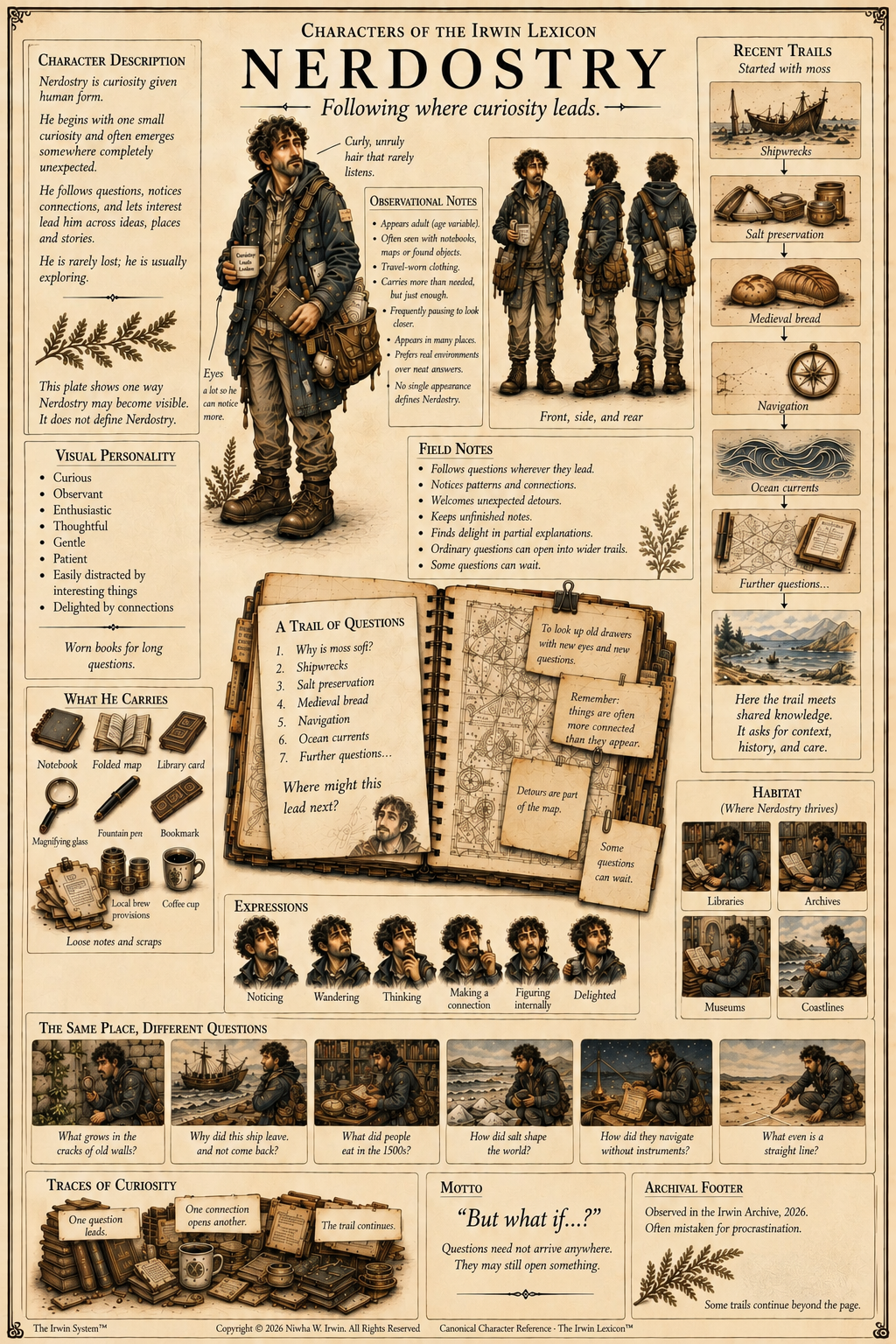
Nerdostry
Following Where Curiosity Leads
Active canon
Recognised when: curiosity remains active and leaves a traceable trail of questions, connections and returns.
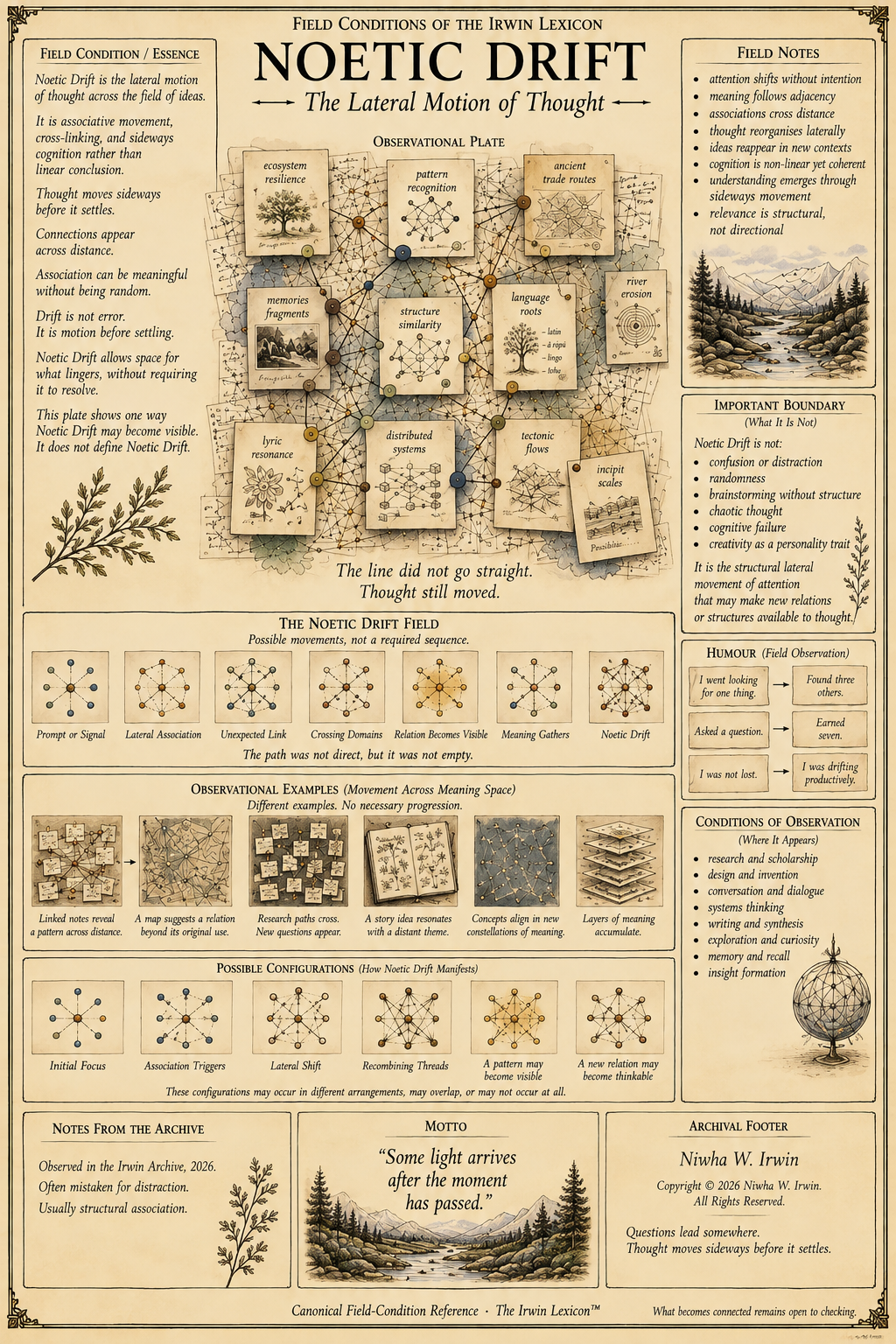
Noetic Drift
The Lateral Motion of Thought
Draft Stub v0.1
Recognised when: thought moves sideways across a field of ideas through meaningful association rather than linear conclusion.
Continuation
Driftlight
The Afterglow of Understanding
Active canon
Recognised when: meaning continues to unfold after an encounter has passed, without requiring immediate clarity or resolution.

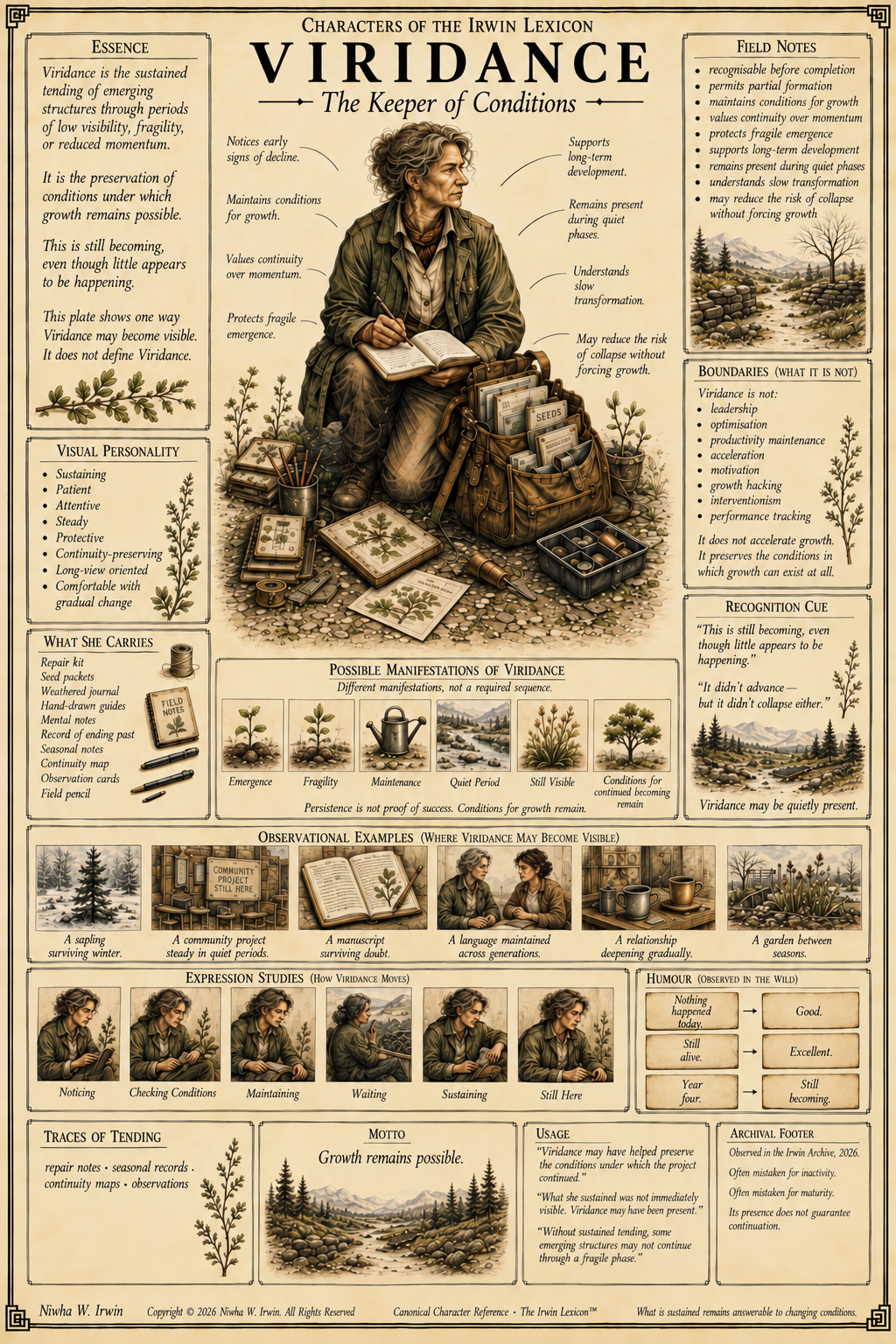
Viridance
The Keeper of Conditions
Draft Stub v0.1
Recognised when: emerging structures are sustained through periods of low visibility, fragility or reduced momentum, preserving conditions under which growth remains possible.
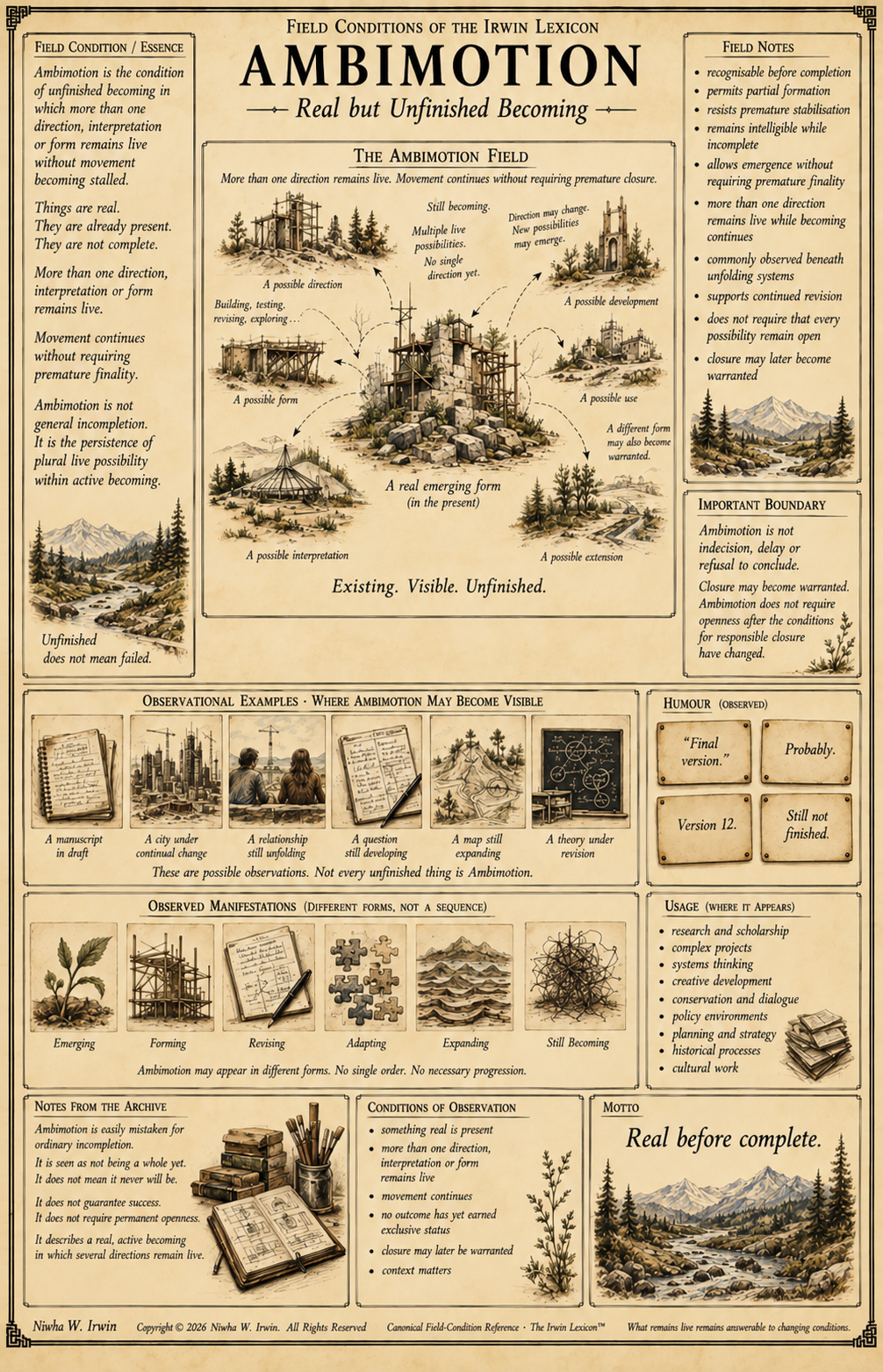
Ambimotion
Real but Unfinished Becoming
Draft Stub v0.1
Recognised when: something real is already emerging while more than one direction, interpretation or form remains live.
Structure
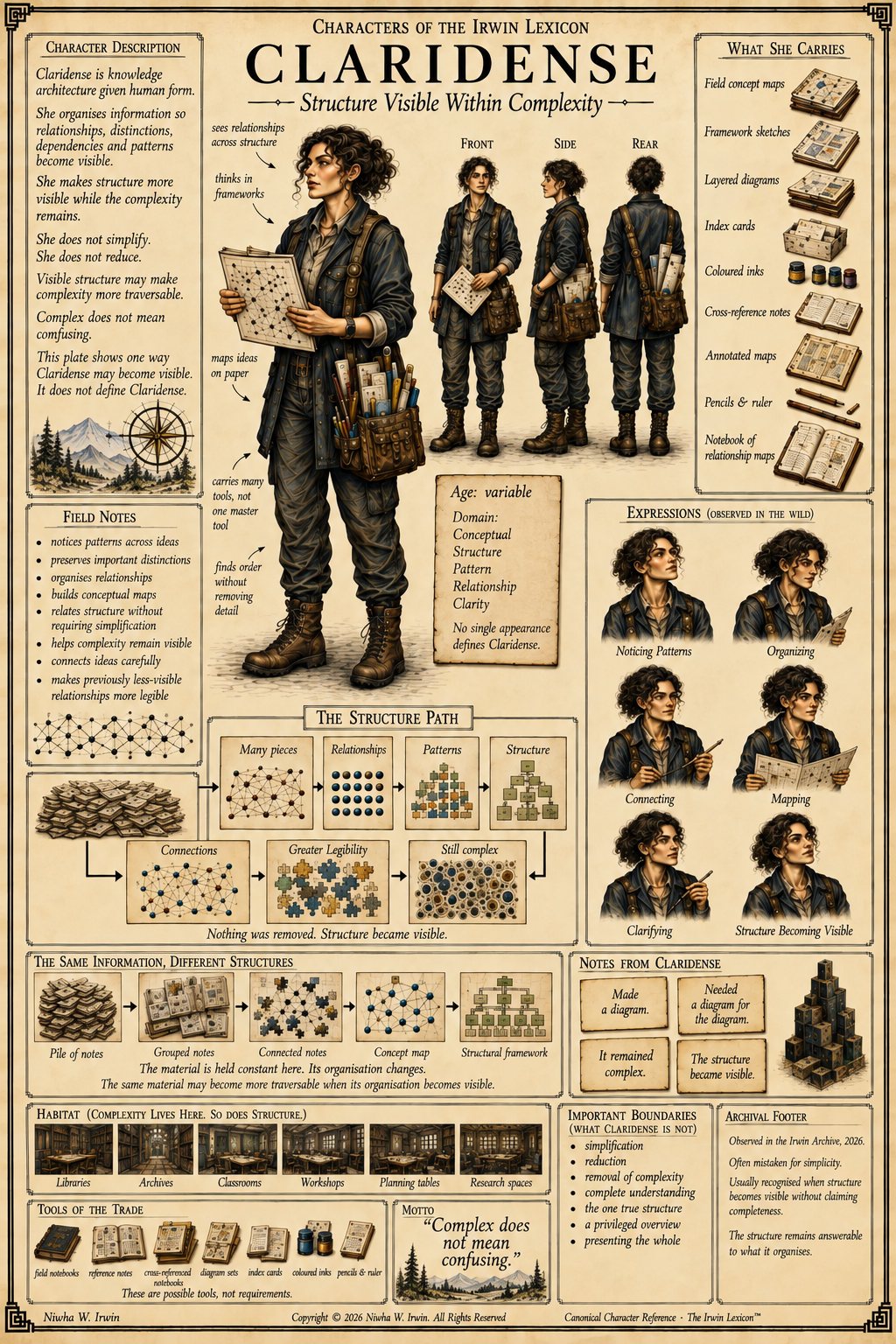
Claridense
Structure Visible Within Complexity
Draft Stub v0.1
Recognised when: organisation makes relationships, distinctions and patterns more visible while the complexity remains.
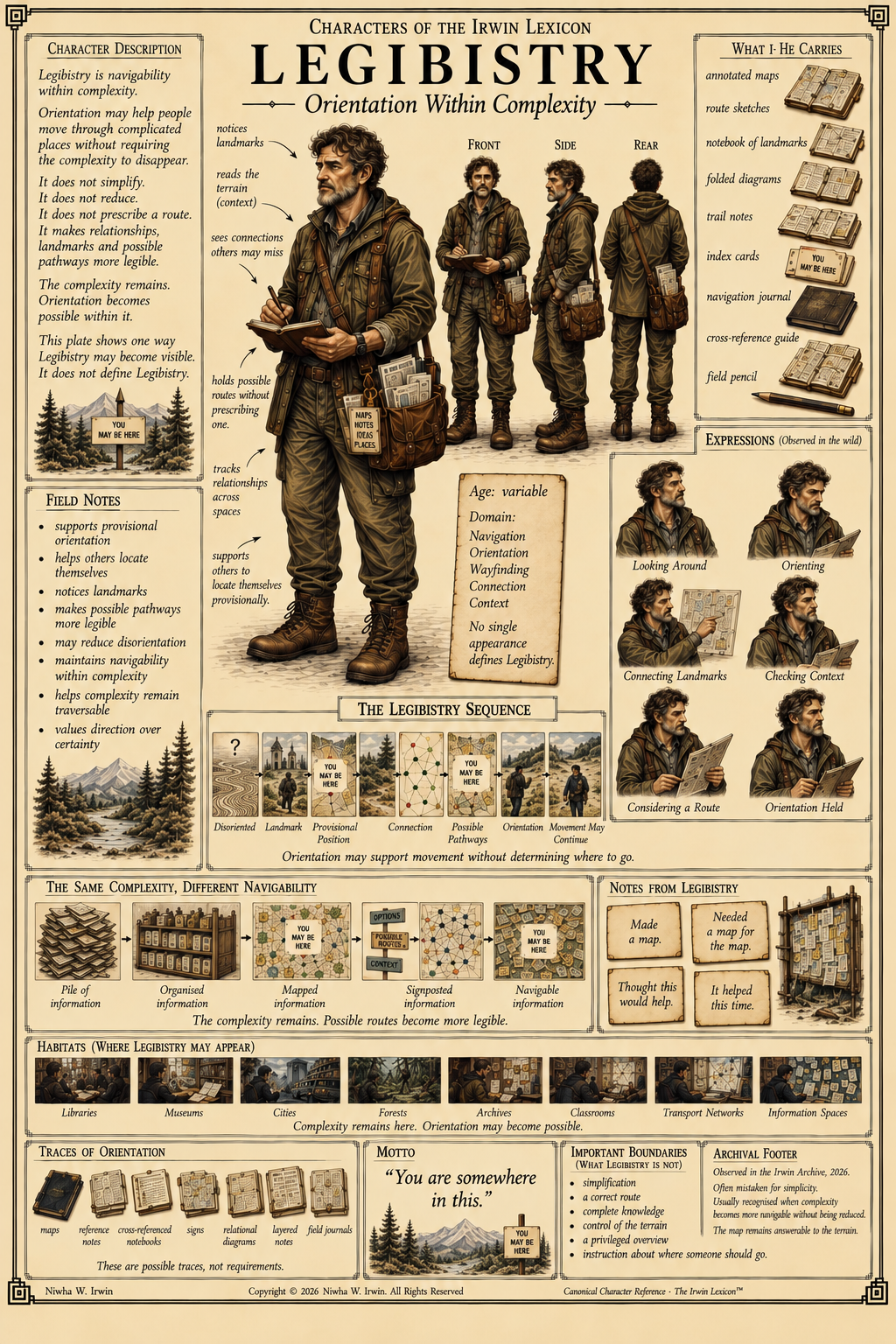
Legibistry
Orientation Within Complexity
Draft Stub v0.1
Recognised when: relationships, landmarks and possible pathways make complexity more navigable without prescribing a single route.
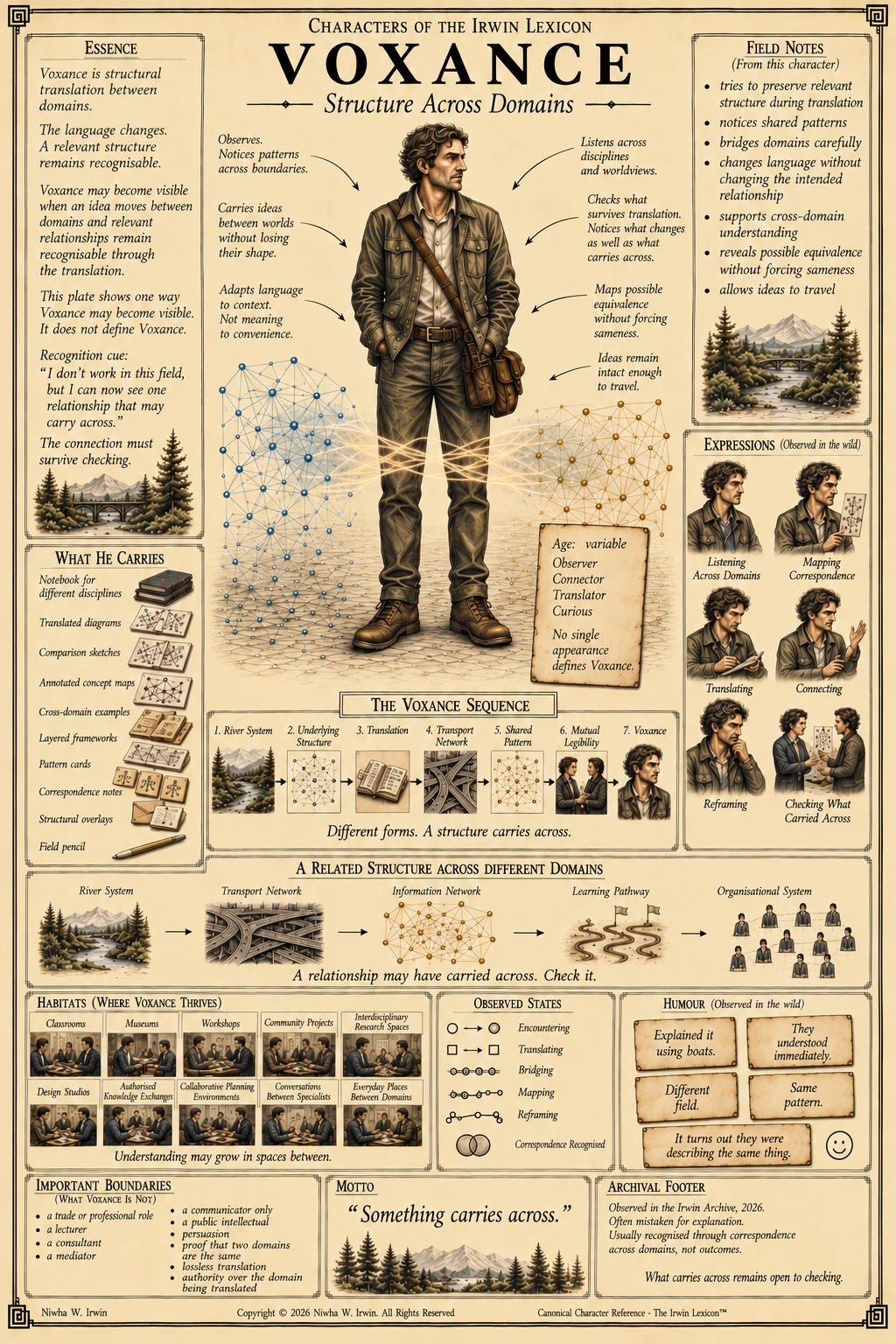
Voxance
Structure Across Domains
Draft Stub v0.1
Recognised when: an idea moves between domains and a relevant relationship remains recognisable through the translation.
Stability / Constraint
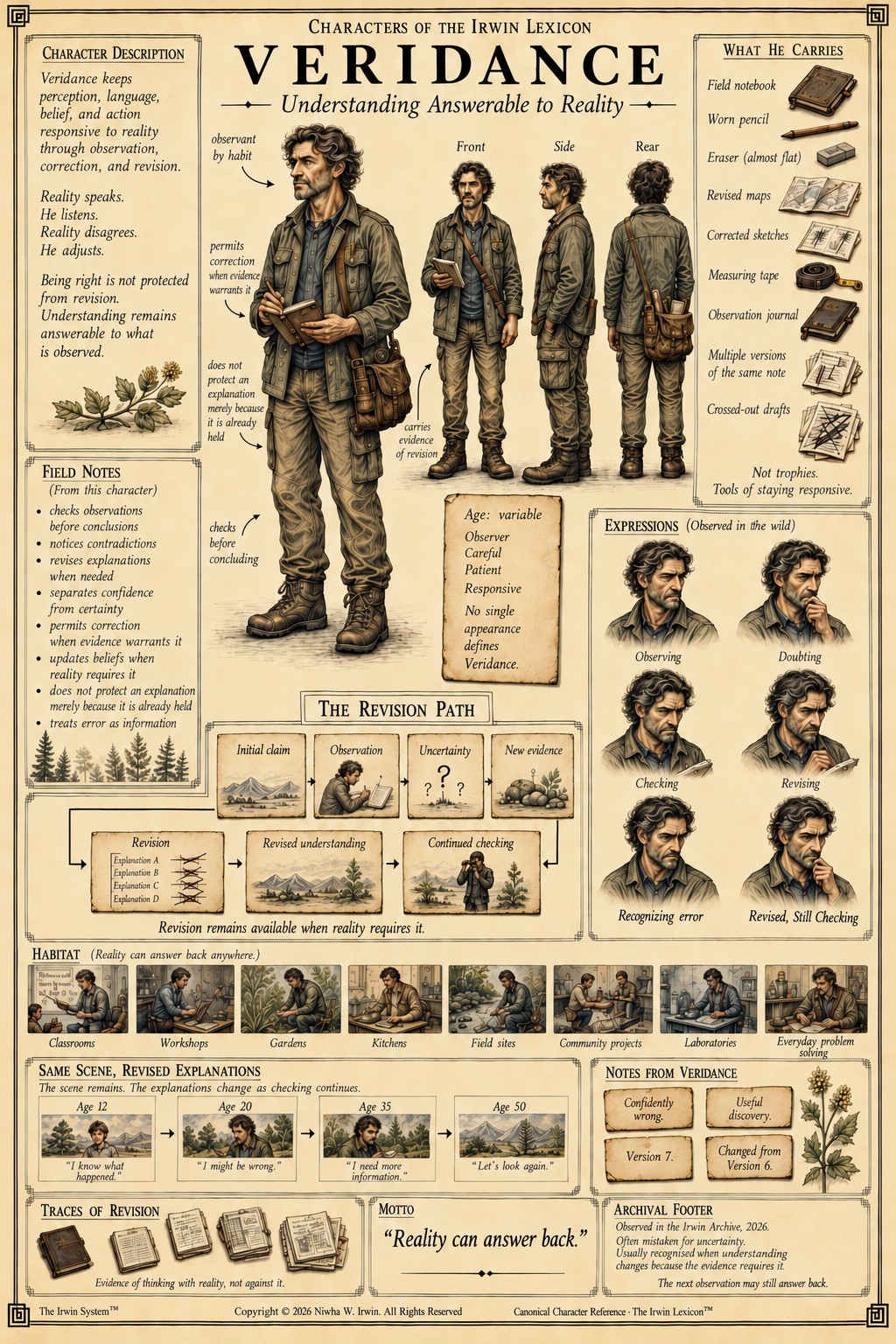
Veridance
Understanding Answerable to Reality
Active canon
Recognised when: understanding remains responsive to observation and is corrected or revised when reality requires it.
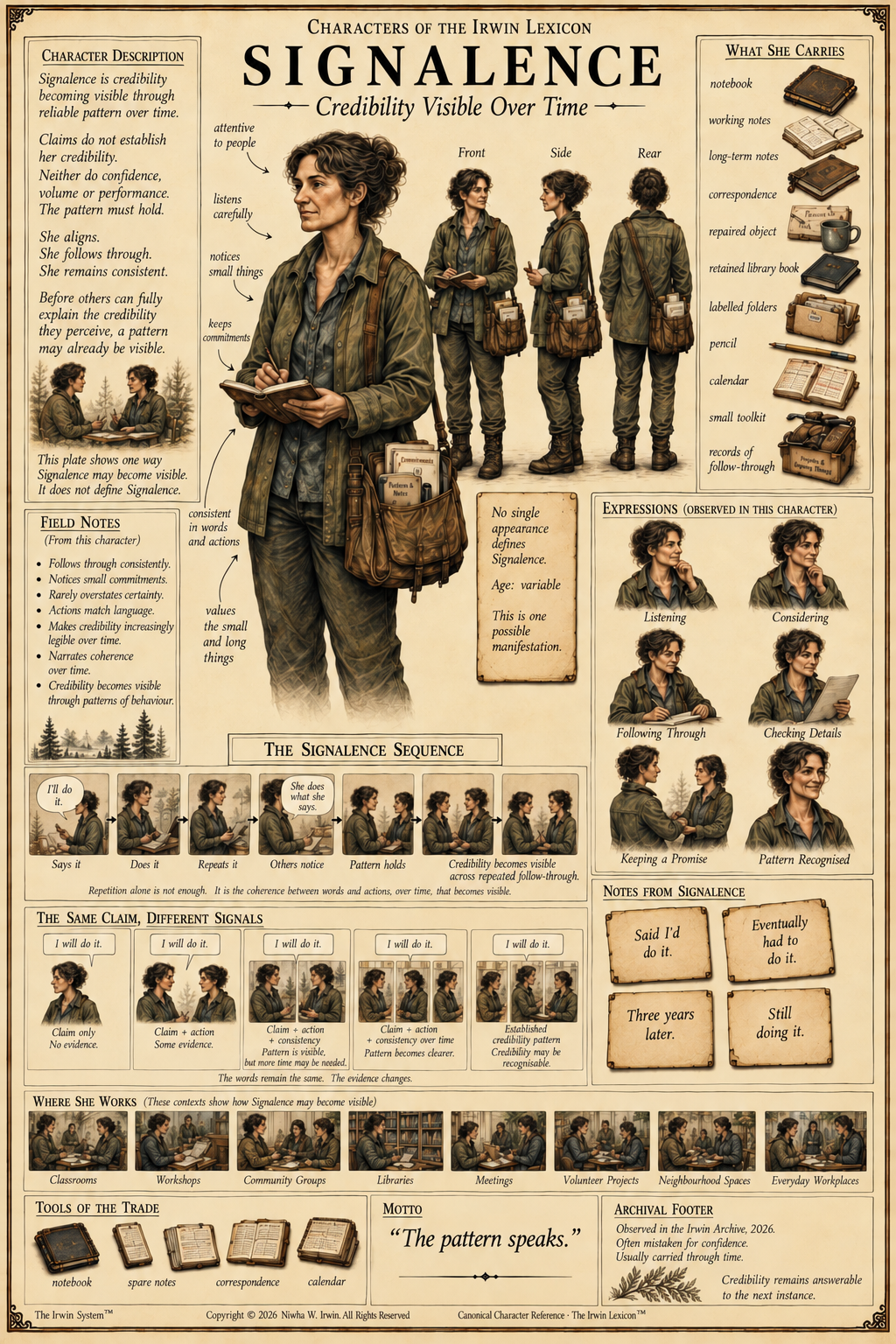
Signalence
Credibility Visible Over Time
Draft Stub v0.1
Recognised when: credibility becomes perceptible through a reliable pattern of words and actions over time.
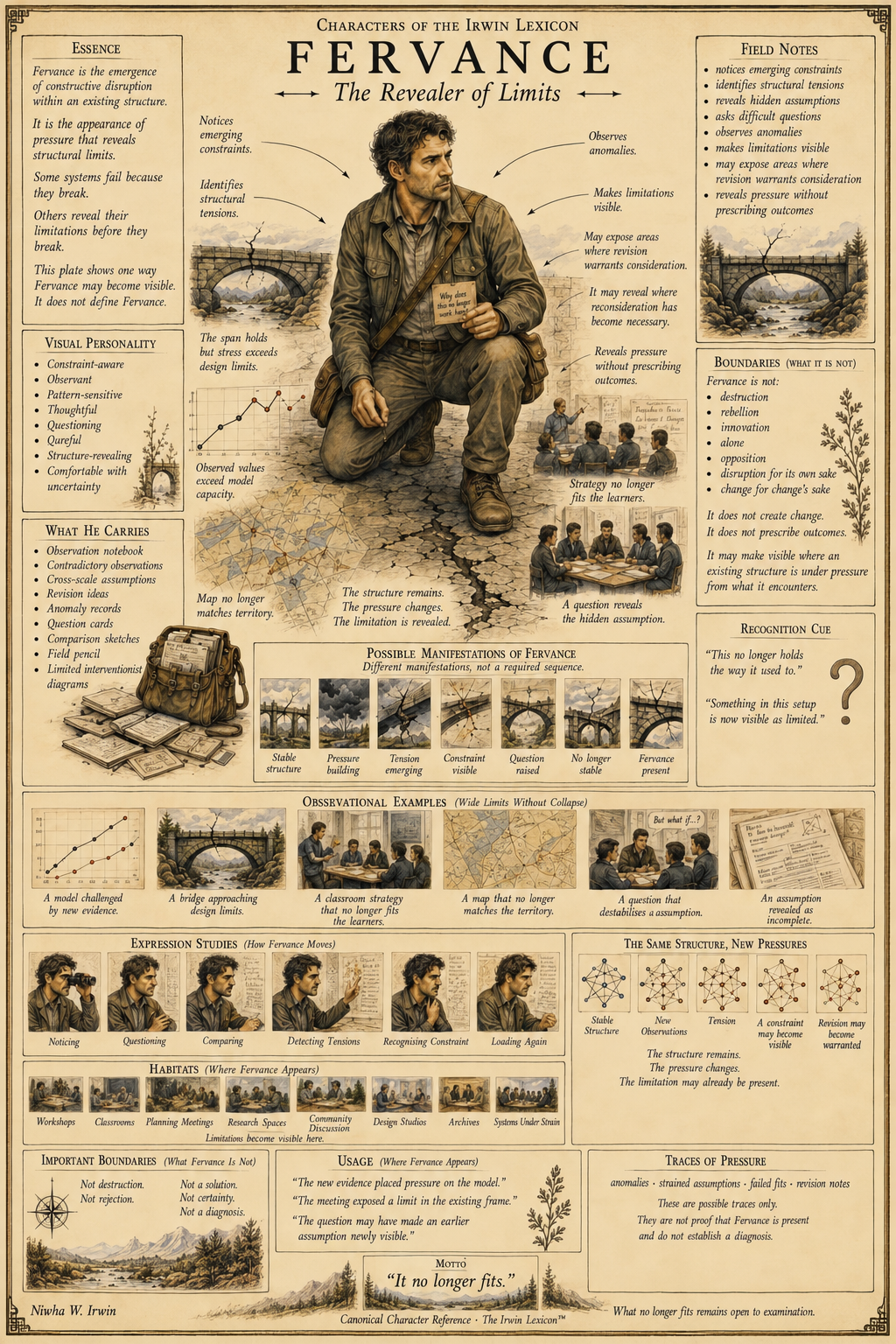
Fervance
The Revealer of Limits
Draft Stub v0.1
Recognised when: constructive disruption or pressure within an existing structure makes a limitation available for examination.
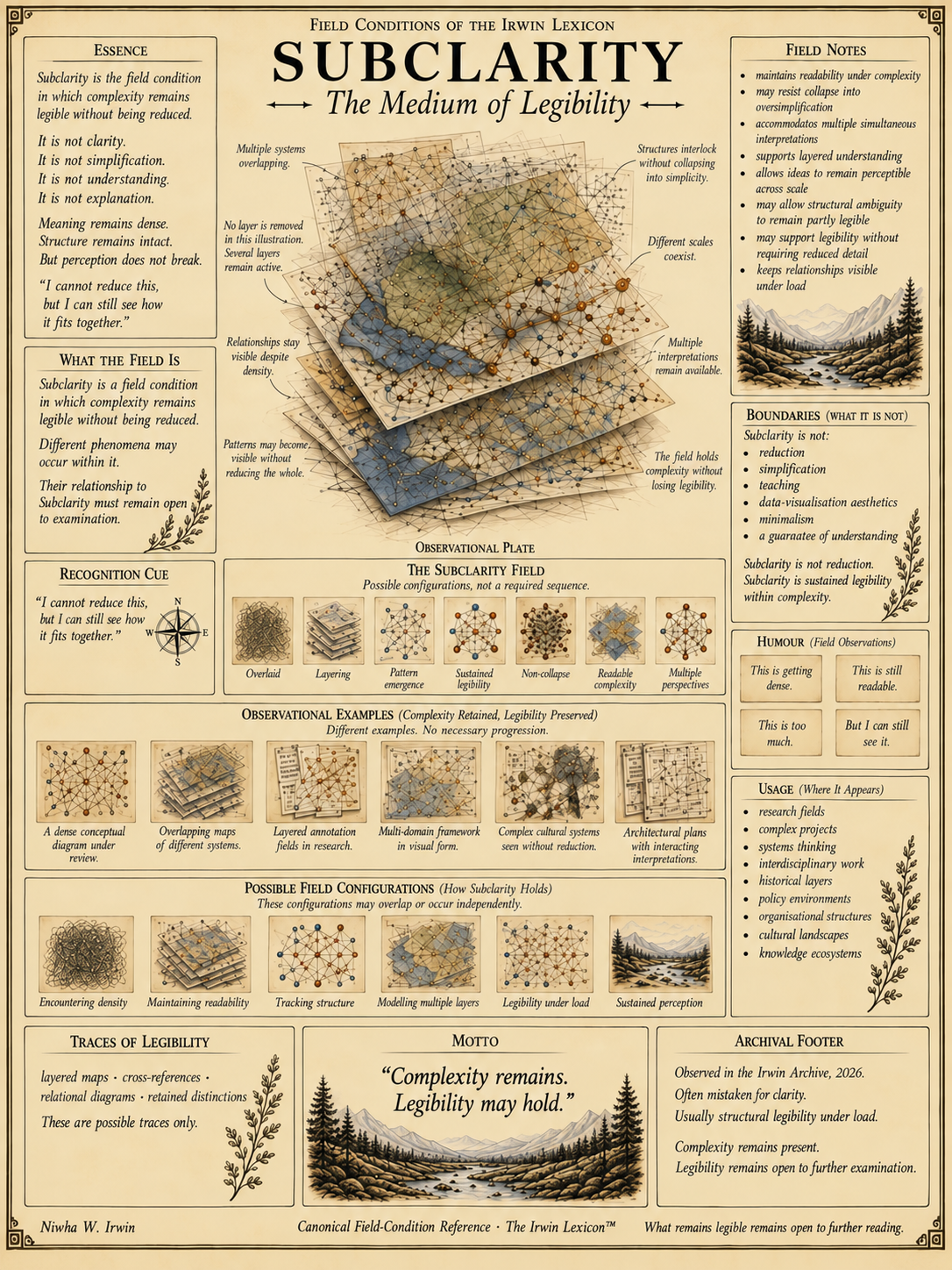
Field Condition / Underlying
Subclarity
The Medium of Legibility
Draft Stub v0.1
Recognised when: complexity remains sufficiently legible without being simplified, reduced or converted into guaranteed understanding.
Relational Field Map
The structure of meaning in motion
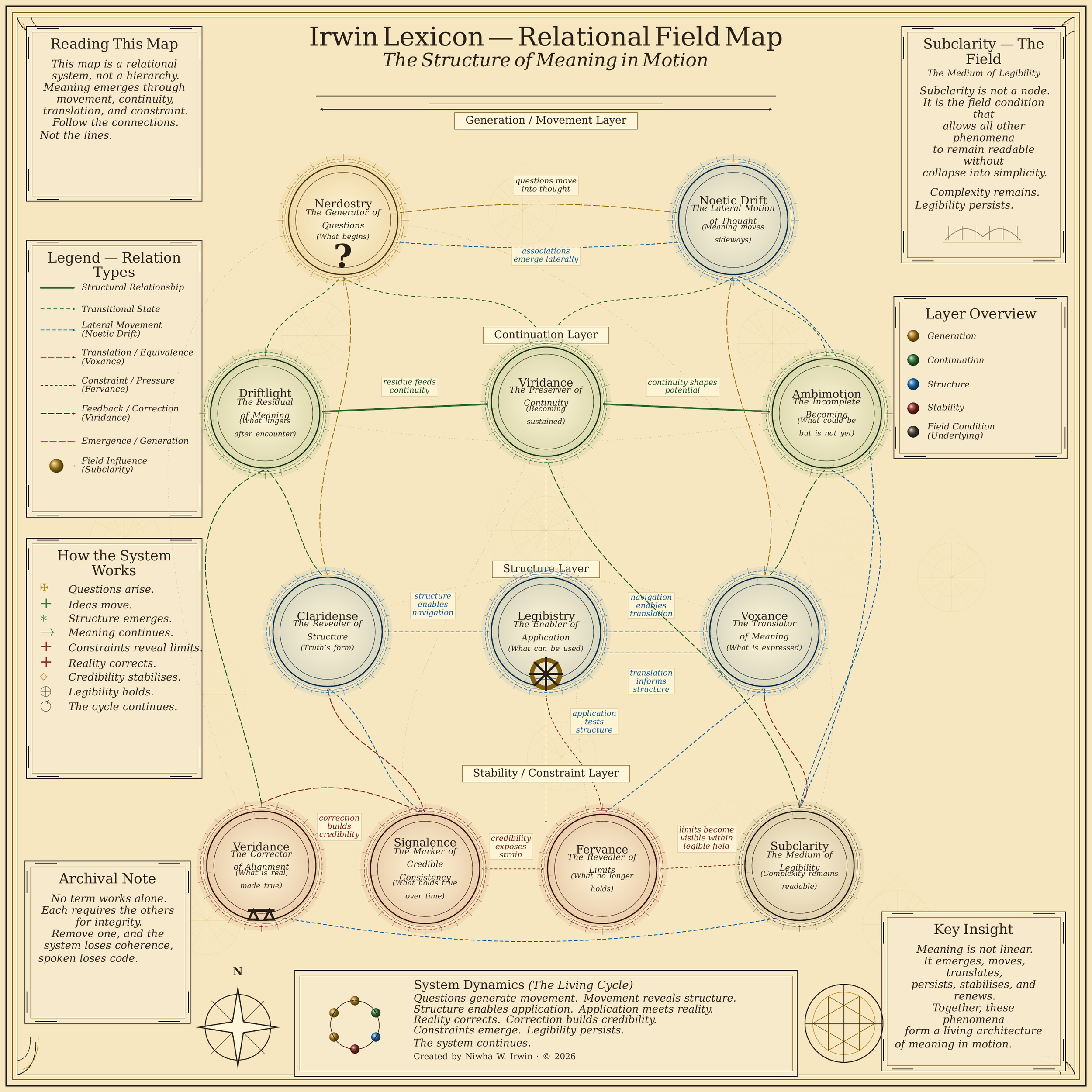
The Relational Field Map shows how selected Irwin Corpus™ Lexicon terms connect across generation, continuation, structure, stability, and constraint. It is not a hierarchy. It is a visual field system showing how meanings move, translate, persist, stabilise, correct, and remain legible together.
Archive Note
This section is still forming.
The materials gathered here represent the current visible layer of the Irwin Corpus™ Lexicon: terms, character plates, maps, field structures, and early navigational records. The archive is not complete, and it is not intended to close the work into a finished theory.
For now, these records should be read as an active field of observation. Some terms are stable. Some relationships are still being tested. Some pathways will become clearer as the Corpus continues to grow.
The work remains open.
Observation remains partial.
The Lexicon will continue to be revised, extended, and clarified as new patterns become visible.