THE IRWIN CORPUS™
The Archive gathers the deeper body of work behind the Irwin System™.
This is where the Irwin Corpus™ is held: foundational works, structural distinctions, corpus grammar, observational atlases, and archive records.
These works are not classroom resources in the usual sense. They are the underlying research, language, and architecture from which the practical resources grow.
This section currently focuses on the Irwin Corpus™.
The Irwin Corpus™ is an observational archive of structure, continuity, memory, and meaning.
It examines how patterns become visible, how relations are carried, how records stabilise memory, and how particular things remain operative beyond the moments in which they first appeared.
The Corpus is not designed as a closed theory. Each work records particular observational structures within defined boundaries.
Observation remains partial.
Observation remains open.
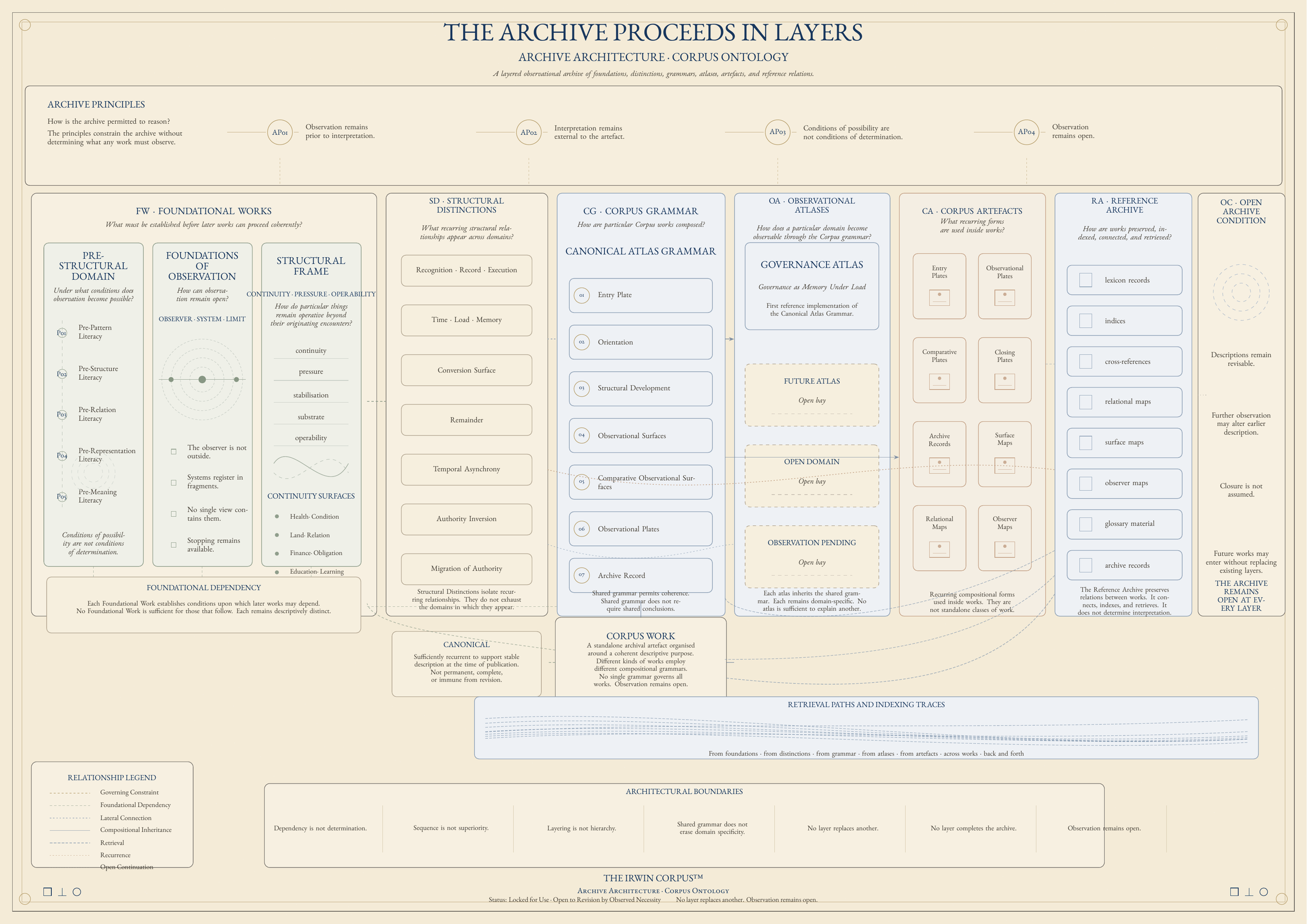
Corpus Map · Archive Architecture
A visual orientation to the layers, dependencies, grammars, atlases, artefacts, and retrieval paths of the Irwin Corpus™. Click the diagram to open the full archive record.
Start Here
Begin here for the opening orientation to the archive.
Architectural Orientation introduces the opening strata of the Irwin Corpus™. It explains how the archive proceeds in layers, beginning with Archive Principles, moving through the Pre-Structural Domain and Structural Frame, and continuing into the Volumes and later observational works.
Start with this orientation if you are new to the Corpus.
Then move to Archive Architecture for the organising map of the archive.
Archive Architecture explains how the Irwin Corpus™ is currently arranged, how its works relate to one another, and how future additions are tested against the existing ontology.
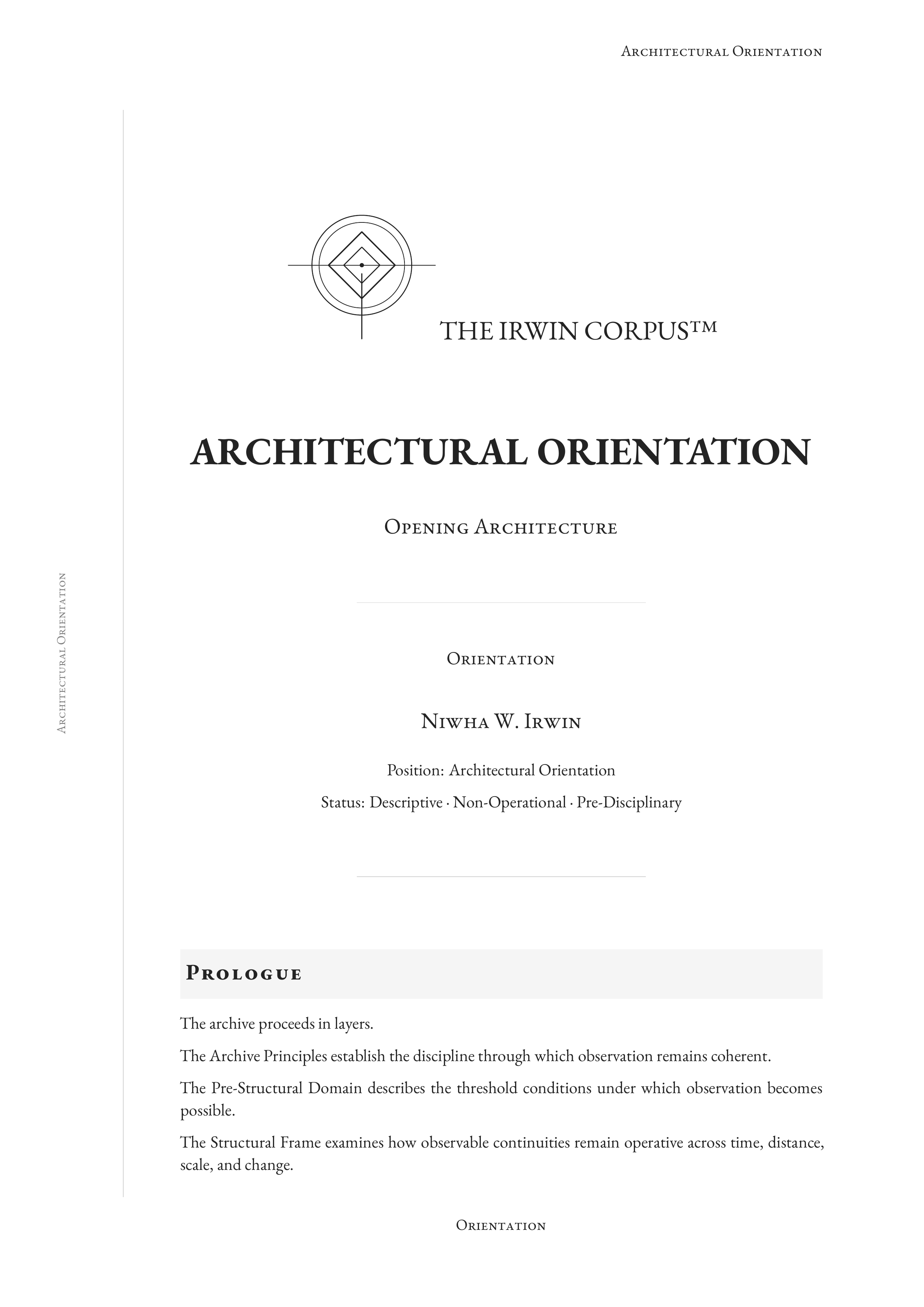
Architectural Orientation
Opening Architecture
Orientation
The opening orientation to the Irwin Corpus™.
This work introduces the archive as a layered body of observation. It names the opening strata: Archive Principles, Pre-Structural Domain, Structural Frame, and the Volumes. It helps the reader understand how the Corpus should be entered before moving into the formal ontology.
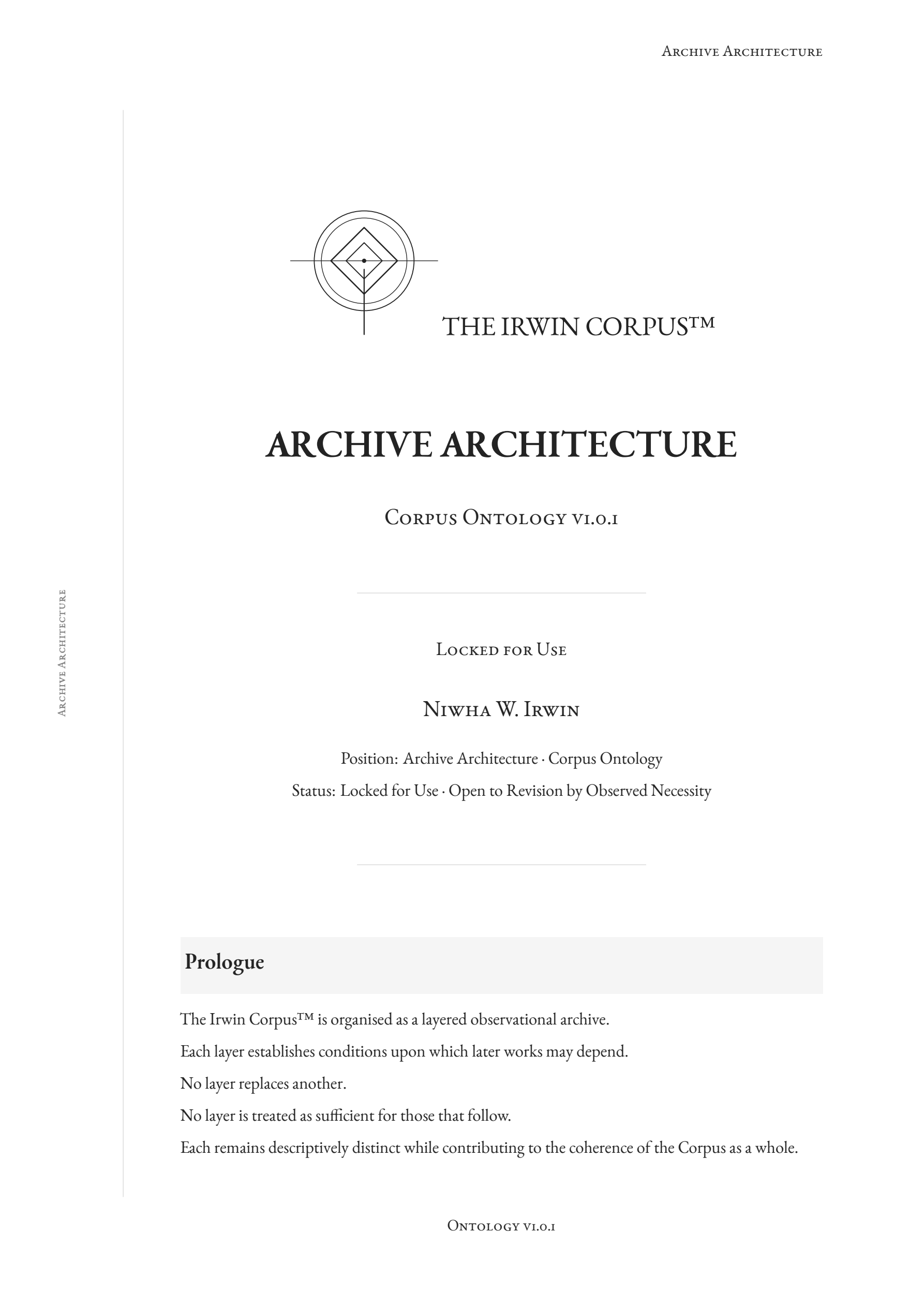
Archive Architecture
Corpus Ontology v1.0.1
Archive Architecture · Corpus Ontology
The current source text for the architecture of the Irwin Corpus™.
This work sets out the structure of the archive, including Foundational Works, Structural Distinctions, Corpus Grammar, Observational Atlases, Corpus Artefacts, and the Reference Archive.
Foundational Works
Foundational Works establish the descriptive conditions upon which later works depend.
They do not determine what follows. They make later observation possible.
Each Foundational Work remains descriptively distinct while contributing to the coherence of the Corpus.
Archive Principles
Plate 000
Foundational Work · Archive Principles
The governing principles of the Irwin Corpus™.
This work establishes the archive’s core discipline: observation remains prior to interpretation, interpretation remains external to the artefact, conditions of possibility are not conditions of determination, and observation remains open.
Pre-Structural Domain
Before the Corpus can examine what is seen, it asks what makes seeing possible.
The Pre-Structural Domain holds the threshold conditions beneath disciplined observation.
Pre-Structural Domain
Threshold Grammar of the Corpus
Foundational Work · Pre-Structural Domain
A threshold work asking under what conditions observation becomes possible.
This work holds the pre-structural conditions beneath pattern, structure, relation, representation, and meaning. It records conditions of possibility rather than stages, mechanisms, or guarantees.
Foundations of Observation
Volume I holds the observational discipline of the Corpus.
It asks how attention can remain open long enough for conditions, limits, and structures to become visible.
Volume I
Foundations of Observation
Foundational Work · In Development
The upstream observational discipline of the Irwin Corpus™.
Volume I asks how observation can remain open without collapsing too quickly into explanation, interpretation, or conclusion. It holds the shift from seeing events to noticing conditions.
Pre-Structural Entry Plates
The Pre-Structural Entry Plates record the conditions that make disciplined observation possible.
They ask when recurrence, organisation, connection, representation, and interpretation become observable before explanation is added.
P01 · Pre-Pattern Literacy
Substrates Beneath Pattern Recognition
Entry Plate · Pre-Structural Domain
This entry plate asks when recurrence becomes observable.
It examines the conditions beneath pattern recognition: noticing, distinction, recurrence, stability, and the possibility of encountering something again.
P02 · Pre-Structure Literacy
Substrates Beneath Structural Recognition
Entry Plate · Pre-Structural Domain
This entry plate asks when organisation becomes observable.
It examines the conditions beneath structure: distinguishable parts, stable relationships, and arrangements that can be observed before explanation, purpose, or meaning is added.
P03 · Pre-Relation Literacy
Substrates Beneath Relational Recognition
Entry Plate · Pre-Structural Domain
This entry plate asks when connection becomes observable.
It examines relation before cause, value, or intention. Some things occur together, influence one another, or remain connected across distance, time, and change.
P04 · Pre-Representation Literacy
Substrates Beneath Representation
Entry Plate · Pre-Structural Domain
This entry plate asks when something can stand for something else.
It examines the conditions beneath representation: symbols, diagrams, narratives, measurements, records, maps, models, and archives.
P05 · Pre-Meaning Literacy
Substrates Beneath Meaning Formation
Entry Plate · Pre-Structural Domain
This entry plate asks when interpretation is observationally supportable.
It examines the conditions beneath meaning, where observations, distinctions, relations, and representations become sufficiently organised to support interpretation.
Structural Frame
Corpus Map · Structural Frame
A visual model of continuity, pressure, stabilisation, substrate, and operability within the Irwin Corpus™. This diagram shows how particular things may remain operative beyond the encounters in which they originated.
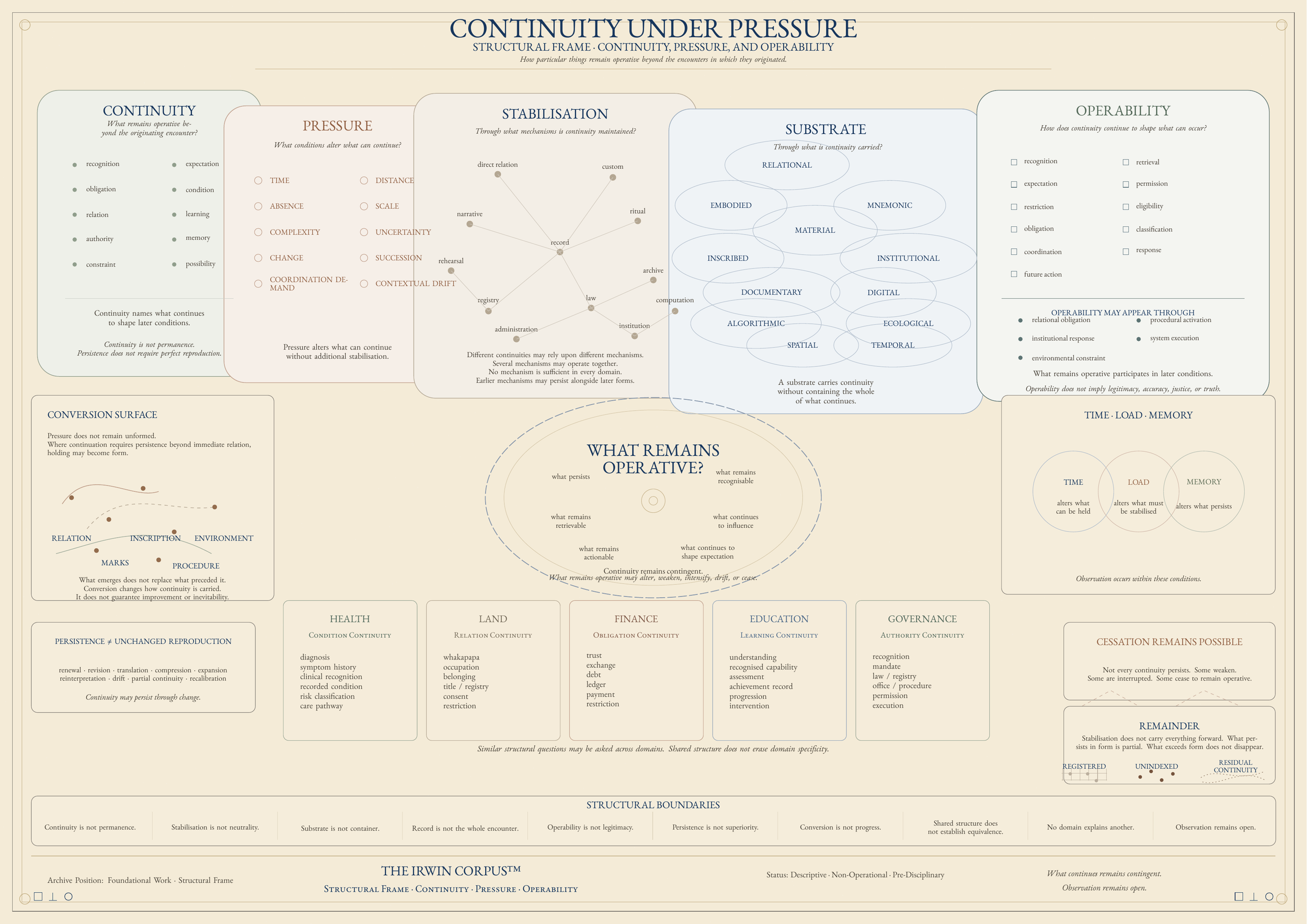
Where the Pre-Structural Domain asks how observation becomes possible, Structural Frame asks how continuity remains operative.
It forms the hinge between the foundations of observation and the later observational atlases.
Structural Frame
Continuity, Pressure, and Operability
Foundational Work · Master Frame
The master continuity frame of the Irwin Corpus™.
Structural Frame examines how particular things remain operative beyond the encounters in which they originated. It observes continuity under pressure across time, distance, absence, scale, and change.
Threshold Foundations
Pre-Structural Domain · Closing Sequence
These plates hold the movement out of the Pre-Structural Domain and toward Structural Frame.
They mark the shift from visibility, to persistence, to limit, without treating that movement as a fixed sequence or final explanation.
Perception · Structure · Limit
Transitional Plate
Pre-Structural Domain · Closing Sequence
A transitional plate holding the movement from visibility toward persistence.
Pattern literacy registers visibility. Structural framing registers persistence. Falsifiability registers limit. Observation continues. Stopping remains available.
Pattern Literacy Bridge
Visibility → Persistence
Closing Plate
Pre-Structural Domain · Closing Sequence
A closing plate linking Pattern Literacy to Structural Frame.
Pattern literacy registers visibility. Structural framing registers persistence. They do not replace one another. They operate across the same field.
Corpus Grammar
Corpus Grammar describes how particular Corpus works are composed.
It governs composition rather than observation. It explains the structure through which a work is organised without prescribing what that work must conclude.
Canonical Atlas Grammar
A Descriptive Grammar for Observational Atlases
Corpus Grammar · Atlas Composition
The compositional grammar for observational atlases within the Irwin Corpus™.
Canonical Atlas Grammar defines the relationship between Entry Plate, Orientation, Structural Development, Observational Surfaces, Comparative Observational Surfaces, Observational Plates, and Archive Record.
Structural Distinctions
Structural Distinctions isolate recurring relationships that become observable across multiple domains.
They do not exhaust the domains in which they appear. They allow comparison while leaving each domain observationally distinct.
Recognition · Record · Execution
Structural Distinction
Registered Continuity
A structural distinction tracing the movement from immediate recognition, to stabilised record, to executable action.
Recognition establishes immediate relational visibility. Record stabilises continuity beyond immediate encounter. Execution acts through the conditions established by prior registration. Observation remains open.
Observational Atlases
Observational Atlases examine particular domains through the Corpus architecture.
Each atlas inherits the Canonical Atlas Grammar while remaining descriptively distinct. Shared grammar supports coherence. It does not require shared conclusions.
Governance Atlas
Governance as Memory Under Load
Observational Atlas · Governance
The first reference implementation of the Canonical Atlas Grammar.
The Governance Atlas examines governance as memory under load, tracing how authority, recognition, record, registration, and execution become observable across relational, documentary, digital, algorithmic, and regulatory substrates.
Reference Archive
The Reference Archive preserves how Corpus works are identified, connected, versioned, and found again.
It records relations without determining interpretation, retains earlier publication states without erasing them, and allows works to be retrieved through multiple entry points.
